
Systems & Infrastructure
Technology & Communications Infrastructure
A campus-wide digital nervous system connecting The Vault, CRC, housing, agriculture, and energy systems into a resilient, fiber-backed, IP-based platform for voice, video, and data.
The STX Resilience Campus is designed to operate like a modern university-and-hospital hybrid: a hardened network core with redundant communications paths, unified safety systems, and always-on visibility during both normal operations and disaster-response activations.
Why Technology Matters for Resilience
Technology on this campus is not an afterthought. It is the connective tissue that joins housing, the CRC, The Vault, agriculture, energy, water, and waste management into a single, coordinated system. A hardened fiber backbone, unified communications, and smart monitoring allow the campus to keep operating safely and intelligently even when the surrounding grid is offline.
Voice, video, and data systems share a common IP-based platform. This allows events in one system to trigger automated responses across others – for example, a security event at a gate can simultaneously alert staff mobile phones and desktop phones, activate the PA and lighting systems in the relevant zone, and bring nearby video feeds into focus on a monitoring wall.
Core Objectives
- Hardened, disaster-resilient communications network: Designed to remain online during hurricanes, grid failures, and extended outages.
- Unified safety and operations: Voice, video, PA, lighting, cameras, access control, and sensors all share a common IP infrastructure.
- Enterprise-grade connectivity: Reliable connectivity for residents, staff, first responders, and emergency operators.
- AI-enhanced situational awareness: Smart analytics on video and sensor data to improve security and response times.
Campus Fiber Backbone
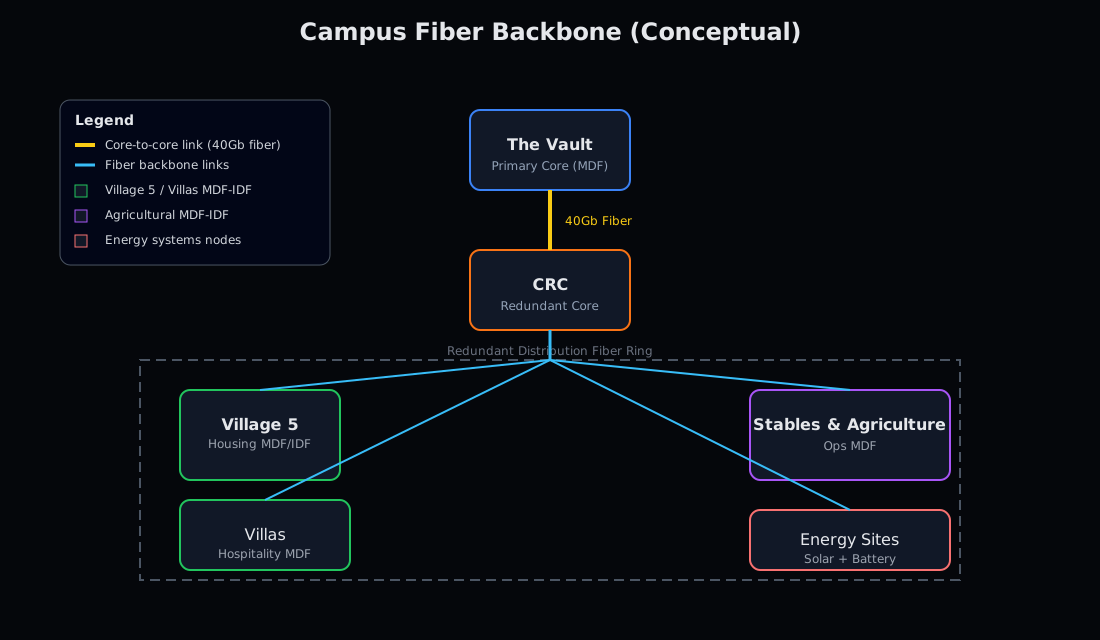
The entire campus is interconnected by a hardened, multi-strand fiber optic backbone. This backbone links The Vault, the CRC, Village 5, the Villas, staff housing, stables, agriculture zones, energy arrays, and key infrastructure nodes with high-bandwidth, low-latency connectivity.
Multiple MDF/IDF locations are strategically positioned in storm-protected spaces. Single-mode fiber links form redundant rings so that if one path is damaged, traffic can reroute automatically. Aruba switches provide the switching fabric, with stacking and link aggregation used to create resilient, high-throughput uplinks (40Gb+ where appropriate) between core and distribution layers.
Power-over-Ethernet (PoE/PoE+) distribution allows IP video endpoints, access control readers, Wi-Fi access points, and VoIP phones to be powered from the switching layer, simplifying deployment and enabling battery-backed operation through the microgrid.
Diagram: Fiber backbone topology linking The Vault (primary core) and the CRC (redundant core) with dual-path distribution to housing, stables, agriculture, and energy sites.
Campus Wi-Fi & Connectivity
Indoor and outdoor Wi-Fi coverage provides ubiquitous connectivity across the campus. Indoor Wi-Fi 6/6E access points serve residences, CRC operations, The Vault offices, staff areas, and common spaces, while weatherproof outdoor units extend coverage across walkways, recreation areas, agriculture zones, and staging fields.
This network supports residents, staff, visiting partners, and emergency personnel, while also carrying critical communications such as Wi-Fi calling, push-to-talk devices, and application traffic for control systems. Even when commercial internet is disrupted, internal Wi-Fi remains available via the microgrid and on-island connectivity, preserving campus communications.
IP Voice & Campus-Wide PA System
The campus uses an IP-based VoIP platform to provide reliable voice communications, integrated directly with IP-based paging and public address systems. Staff and operators can dial extensions campus-wide, join hunt groups, and place priority calls during an incident, whether from desk phones, wireless handsets, or softphones.
A SIP-based paging system (similar in concept to SYN-Apps/Symphony-class solutions) allows announcements to be broadcast to specific zones or the entire campus: the CRC, Village 5, Villas, stables, agriculture areas, The Vault, and perimeter access points. This PA system can be triggered manually or automatically from defined events, such as weather alerts, access control alarms, or analytics from the video security system.
Because VoIP and PA share a common IP backbone, they can continue functioning during grid outages by drawing power from the microgrid and battery storage. Satellite or cellular backup links can be used to maintain external voice connectivity when terrestrial circuits are down.
Intelligent Safety & Mass Notification Platform
On top of the core voice, video, and data infrastructure, the campus deploys an intelligent safety and mass notification platform that ties together badges, sensors, strobes, clocks, displays, and mobile devices into a single, coordinated response system. Staff can trigger an alert from a wearable badge, wall station, or mobile app, and the system automatically routes the right type of notification to the right audience.
Using long-range Bluetooth and location-aware beacons, the system can pinpoint where an alert originated and who triggered it, then coordinate a multi-channel response: activating color-coded strobes, taking over digital clocks and hallway displays with scrolling text, pushing notifications to staff mobile phones, and broadcasting targeted messages over the PA system. In more severe events, it can escalate to campus-wide alerts and inform first responders of the exact building and room involved.
This platform can also integrate with weather and public alert feeds so that, for example, a hurricane warning automatically sets strobes to a specific color and pushes a consistent message across speakers, displays, and mobile notifications. All events are logged centrally for post-incident review and continuous improvement of campus safety procedures.
Video Security & AI-Assisted Monitoring
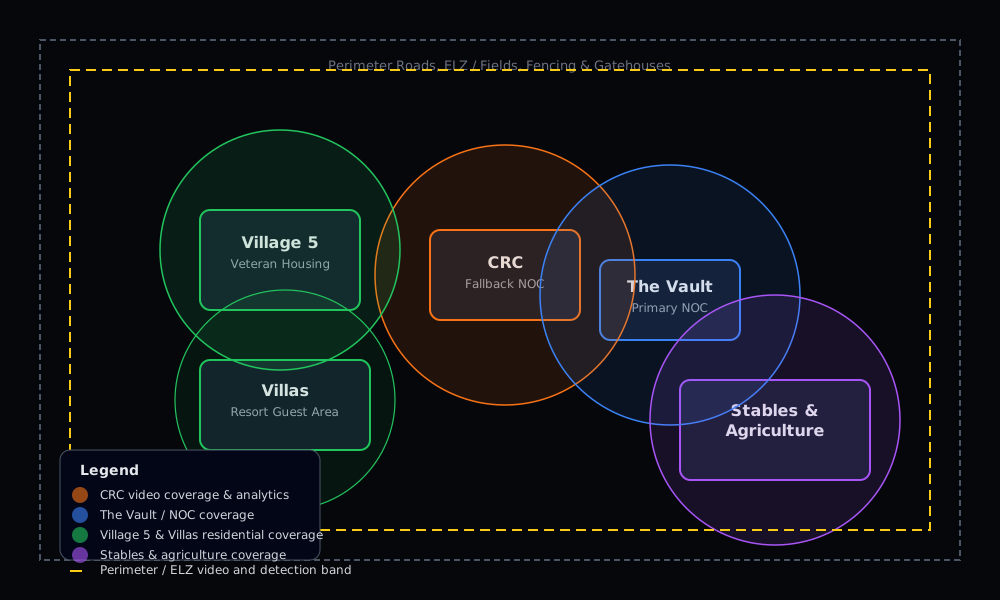
The campus deploys a network of high-resolution IP video endpoints—fixed and PTZ cameras—at key locations: campus entries, CRC approaches, The Vault, stables, agriculture perimeter, Villas, staff housing, recreation and aquatics, and utility zones. These video endpoints are network-powered via PoE and backhauled over the fiber backbone to recording and monitoring systems.
AI-enhanced analytics support motion detection, people and vehicle recognition, loitering and intrusion alerts, and behavior-based event flags. When specific patterns are detected—for example, after-hours movement in a restricted zone—the system can:
- Generate alerts in the Network Operations Center dashboards.
- Trigger context-relevant PA and lighting responses in nearby zones.
- Bring associated video feeds into focus on an operator’s display wall.
- Tag video segments for quick review and incident documentation.
Diagram: Conceptual video coverage and analytic zones around CRC, The Vault, Village 5, Villas, stables, and the perimeter. (Not to scale.)
Smart Access Control & Perimeter Security
Entry points across the campus use modern access control technologies: smart card or fob readers, NFC or mobile credentials, and PIN pads for designated locations. Access events are logged centrally and associated with video and voice records for a unified security history.
Gate intercoms and door stations utilize VoIP to allow two-way audio from CRC operators or security personnel in The Vault, with the ability to trigger PA announcements, adjust lighting in the affected area, unlock or lock doors, and escalate events as needed. In emergency scenarios, global lockdown or unlock commands can be issued for pre-defined groups of doors to support evacuation, shelter-in-place, or public-safety ingress.
Network Operations Centers: The Vault & CRC
The campus uses a dual-NOC design to maintain control and visibility even when one facility becomes inaccessible. The primary Network Operations Center (NOC) is housed inside The Vault, the hardened facility specifically designed to protect mission-critical systems. A secondary, fallback NOC is located within the CRC to serve as the incident command center during disaster-response operations.
Primary NOC – The Vault
The Vault functions as the main technical core of the campus, with:
- Core Aruba switching fabric and routing.
- Primary firewalls and network security appliances.
- Virtualization hosts and application servers.
- Primary NVR storage for video security systems.
- Access control and identity management systems.
- Voice, PA, and intelligent safety integration servers.
- Microgrid, water, energy, and waste control backends.
- Long-term logging and analytics platforms.
The Vault is hardened, secure, climate-controlled, and tied directly into the microgrid and backup power systems, allowing it to operate as a Tier-2 datacenter on campus.
Secondary / Fallback NOC – CRC
The CRC hosts a smaller, but highly capable fallback NOC that serves as the campus command center during hurricanes, grid outages, and major incidents. This NOC provides:
- Redundant switching and routing paths back to The Vault and campus fiber backbone.
- Disaster-mode dashboards for video, access control, PA, and intelligent safety alerts.
- Satellite and cellular failover links for external connectivity.
- Local recording buffers for critical video feeds.
- Emergency PA and message override controls.
- Monitoring of energy, water, and waste systems at a summary level.
In an extreme scenario where The Vault is inaccessible due to debris or localized damage, CRC operators can maintain command and control from this fallback NOC. In normal conditions, it can be used for training, situational awareness, and small-scale operations while keeping The Vault secured.
Emergency Communications & Redundancy
To support operations when commercial infrastructure is compromised, the campus integrates multiple redundant communication paths:
- Satellite internet links in hardened mounts for backhaul connectivity.
- Cellular booster / DAS systems to reinforce on-site mobile coverage.
- Optional ham/GMRS gateways for worst-case radio communications.
- Direct integration with weather and alert feeds to trigger PA, lighting, displays, and mobile messaging.
These links are tied into both The Vault and CRC NOCs, allowing either location to maintain external communications. Internally, the fiber backbone and Wi-Fi mesh ensure that local voice, video, data, and safety systems remain available even when commercial circuits are down.
Integration With Other Campus Systems
The technology backbone is designed from the outset to integrate tightly with the campus energy, water, waste, housing, and agriculture systems. Sensors, controllers, and meters report into unified dashboards, allowing operators to see the health of the microgrid, tank levels, pump status, fire systems, and critical campus systems all in one place.
This “single pane of glass” approach simplifies staff workload, improves response times, and supports data-driven decision-making for both day-to-day operations and disaster-response scenarios. It also strengthens the project’s case with investors and agencies by demonstrating that resilience, safety, and sustainability are built into the campus at the systems level—not bolted on afterward.
A Digital Nervous System for the Campus
Taken together, the fiber backbone, Wi-Fi mesh, VoIP and PA systems, intelligent safety and mass notification platform, video security, access control, dual NOCs, and redundant communication paths create a true digital nervous system for the STX Resilience Campus. This infrastructure allows the campus to function as a modern, intelligent, and secure hub for veterans, local residents, and emergency operations.
For investors, federal partners, and local stakeholders, this design reduces risk, improves operational continuity, and positions the campus as a regional leader in resilient infrastructure and humanitarian response capability.